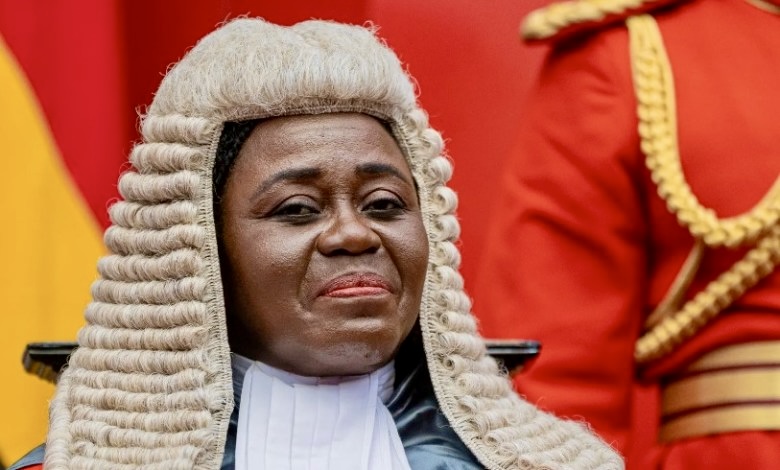
The ECOWAS Community Court of Justice (ECOWAS Court) has dismissed a request by former Chief Justice Gertrude Esaaba Torkornoo for interim measures to stop the fact-finding committee probing her removal.
On April 22 2025, President John Dramani Mahama, acting on petitions asserting misconduct, suspended Justice Torkornoo and established a committee into her conduct.
Justice Torkornoo applied in early July 2025 to the ECOWAS Court seeking temporary orders to halt the committee’s investigations. Her claim: the inquiry violated her human rights and undermined her constitutional authority.
On Wednesday 19 November 2025, the ECOWAS Court dismissed her application for interim relief. The Court found she failed to show evidence of imminent or irreparable harm justifying such relief.

The judges noted that she waited nearly three months after her suspension before applying, which weakened her claim of urgency. The Court also held that because the urgency requirement was unmet, it did not proceed to examine the remaining criteria for interim measures.
The Ghanaian government, via the Office of the Attorney‑General of Ghana, had argued that the ECOWAS Court lacked jurisdiction because domestic courts in Ghana were already seized of related issues. The Court rejected this objection.
The Court clarified that the “sub judice” rule applies only when a matter is awaiting judgment in another forum—not merely because similar facts are before domestic courts.
While the interim relief was refused, Justice Torkornoo’s substantive case is still admissible before the ECOWAS Court. The government now has 30 days to file its response.
The decision means the fact-finding committee may continue its work without being halted by the regional court. For Justice Torkornoo, the refusal increases pressure to win the main case rather than rely on stopping the process.
Observers will watch how the ECOWAS Court handles the substantive human rights arguments and whether jurisdiction and procedural fairness issues will shape the outcome.