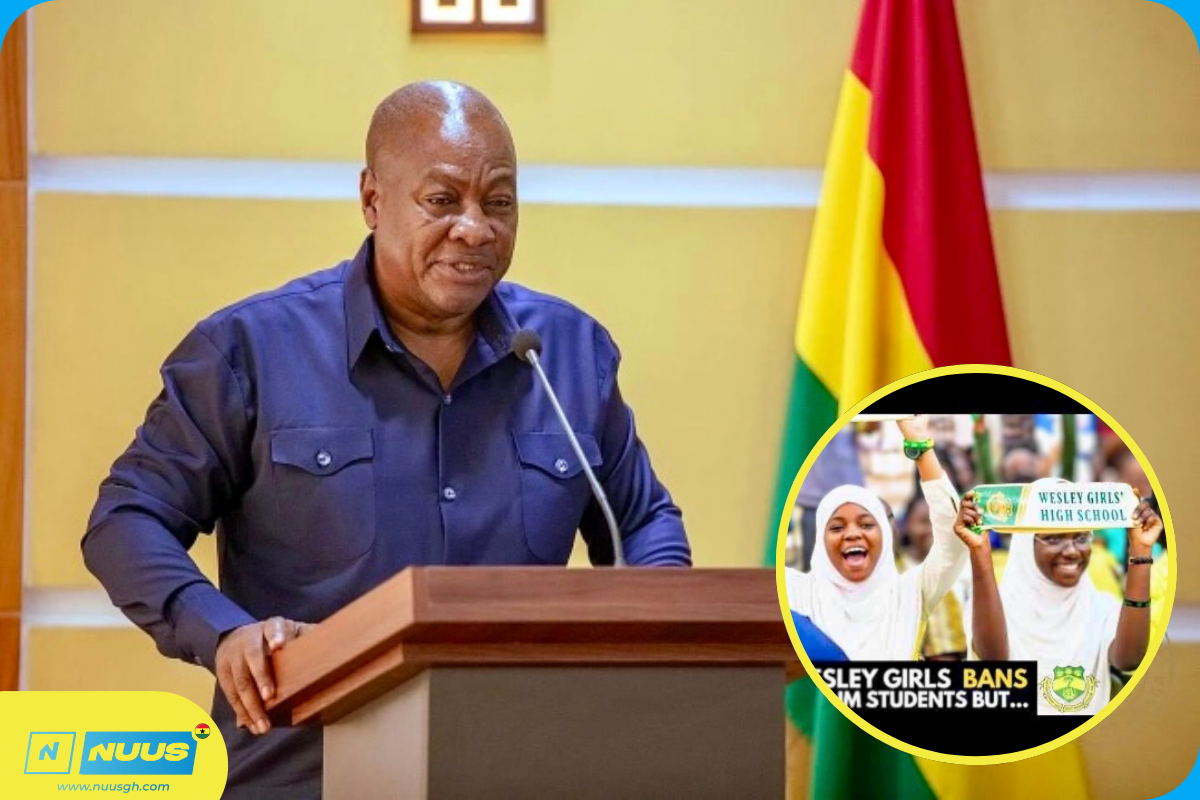
President John Dramani Mahama has stepped into a heated debate about religious rights at mission schools. He called on faith-based school authorities to respect religious diversity and follow agreed rules that protect every student’s right to worship freely. His remarks came amid a growing legal case against Wesley Girls’ Senior High School in Cape Coast.
The controversy began when a lawyer, Shafic Osman, filed a Supreme Court suit in December 2024. He argued that Wesley Girls’ policies restrict Muslim students from practicing their religion, such as observing prayer and fasting during Ramadan. The lawsuit claims these restrictions violate several parts of Ghana’s 1992 Constitution, including freedom of thought and belief.
During a meeting with the National Peace Council on December 10, Mahama said an earlier Memorandum of Understanding (MoU) among faith-based organizations already set clear expectations. That agreement calls for recognition of religious diversity in mission schools. Mahama said he could not understand why the dispute had reached the courts when the agreement was already in place.
Mahama did not address the specific claims against Wesley Girls directly but stressed the need for respect and cooperation. He said the Supreme Court must now consider the case and that its decision will help clarify how religious freedoms should be upheld in educational settings.
The Supreme Court, led by Justice Gabriel Scott Pawmang, ordered the school’s Board of Governors to answer the allegations within 14 days. The court expressed concern that earlier responses did not fully address the core issues raised in the case.
The dispute has drawn wide attention. Muslim leaders have called for presidential intervention to ensure the rights of Muslim students. Some political figures have warned that unresolved religious tensions in schools could weaken Ghana’s long history of peaceful coexistence.
Education Minister Haruna Iddrisu has also weighed in. In Parliament, he reiterated the government’s duty to protect the rights of all students, regardless of faith. This position has drawn mixed reactions from religious groups. While some support stronger religious inclusion, others argue mission schools must retain their founding identities.
The Christian Council of Ghana recently urged the plaintiff to consider settling the matter through dialogue instead of continued litigation. Council leaders said a negotiated solution might preserve harmony while respecting constitutional rights.
As the Supreme Court prepares to hear the case, the broader debate continues in public and religious circles. Many see this moment as a key test of how Ghana balances the historical traditions of mission schools with modern expectations of religious freedom in state-supported institutions.